Learn how HVAC companies can use local SEO, Google Business Profile optimization, reviews, citations, and local content to rank higher and attract more leads.
.png)
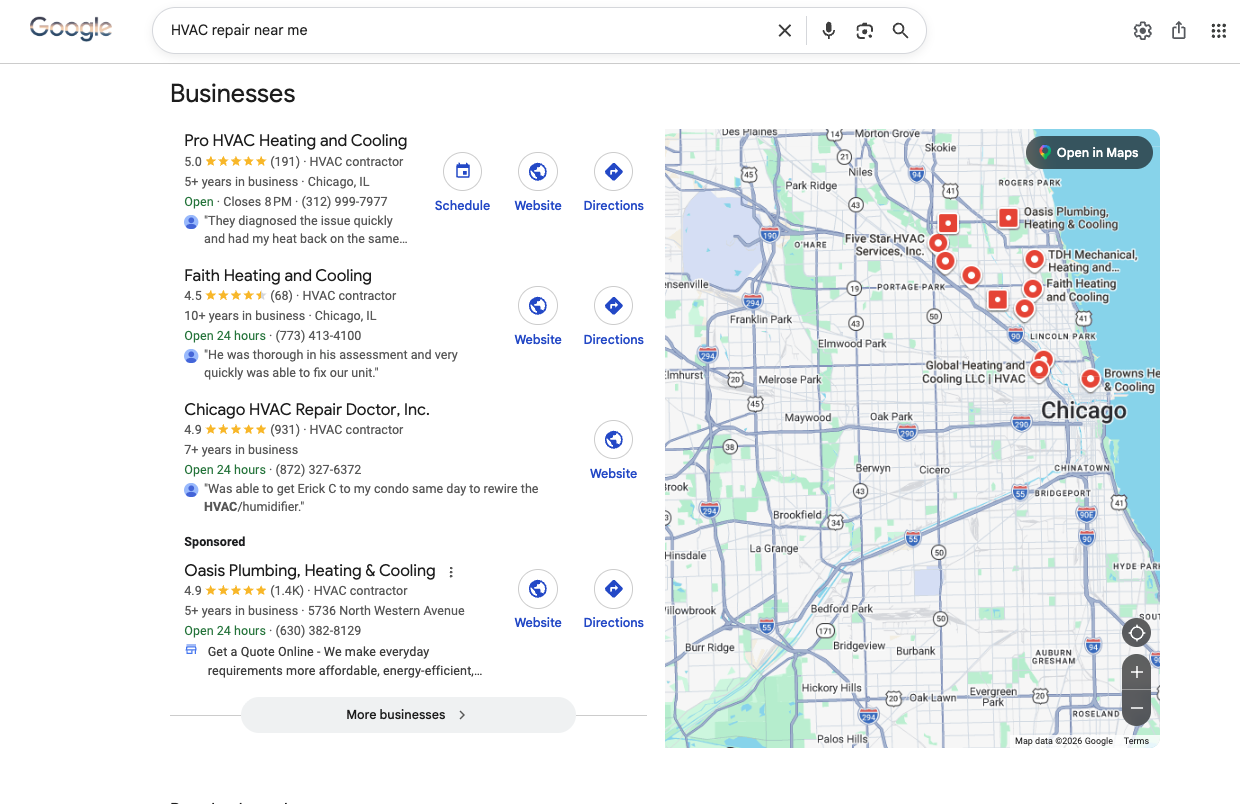
When a homeowner's furnace stops working on a freezing January morning or an air conditioner dies during a summer heatwave, they do not reach for a phone book. They pull out their smartphone, open a search engine, and type something like "HVAC repair near me." Within seconds, they are looking at a handful of local businesses, reading reviews, comparing star ratings, and deciding who to call. If your HVAC company is not showing up in that critical moment, you are losing business to a competitor who is.
This is the reality of modern home services marketing. National advertising campaigns and generic websites are no longer enough to keep a local HVAC business thriving. For home improvement companies, visibility in local search results is essential. That is where local SEO comes in.
Local SEO is the practice of optimizing your online presence so that your business appears prominently when people nearby search for the services you offer.
For HVAC providers, this is not a nice-to-have marketing tactic; it is the backbone of sustainable lead generation. Unlike a plumber someone might drive across town for, HVAC customers overwhelmingly choose companies close to home, ones they trust to arrive quickly and know the local climate demands.
This guide breaks down exactly how HVAC service providers can build a strong local SEO strategy, attract more qualified leads, and outrank competitors in their service area.
Before diving into tactics, it helps to understand why local search carries so much weight for this industry specifically. HVAC services are almost always tied to urgency and location. Nobody searches for "furnace repair" while lounging on vacation three states away; they search because their system just failed and they need someone nearby, often the same day.
Search engines recognize this pattern and prioritize local relevance in their results. When someone searches for "AC repair" or "heating installation," search engines pull up a local map pack, a set of three business listings shown alongside a map, along with organic results tailored to the searcher's location.
Studies on consumer search behavior consistently show that a large share of local searches lead to a phone call or a store visit within a day, which makes ranking in that map pack one of the most valuable pieces of digital real estate an HVAC company can occupy.
Beyond urgency, trust plays a major role. Letting a technician into your home to service expensive equipment requires confidence. Local SEO signals, such as reviews, business longevity, and community presence, help build that trust before the first phone call is even made. Companies that invest in local SEO are not just chasing clicks; they are building the kind of credibility that turns a first-time customer into a repeat client for years of maintenance, repairs, and eventually system replacements.
If there is one single asset that matters most for local SEO, it is your Google Business Profile. This free listing is often the first thing potential customers see, and it directly influences whether your business appears in the coveted map pack.
Start by claiming and verifying your profile if you have not already. From there, accuracy and completeness are everything. Your business name should match exactly what appears on your website and other listings; do not stuff it with extra keywords like "Best HVAC Repair" if that is not your actual registered name, since this violates guidelines and can get your listing suspended. Your address, phone number, and hours need to be correct and consistent everywhere they appear online, a concept known as NAP consistency, which stands for name, address, and phone number.
Choose your business categories carefully. "HVAC Contractor" should typically be your primary category, but you can add secondary categories such as "Air Conditioning Repair Service" or "Furnace Repair Service" to capture a broader range of searches. Fill out every available field, including service areas, business description, and attributes. Upload high quality photos regularly, showing your trucks, technicians at work, completed installations, and your team. Listings with photos receive significantly more engagement than those without.
Do not overlook the Products and Services section within your profile. List out specific offerings like AC installation, furnace repair, duct sealing, indoor air quality solutions, and maintenance plans. This helps search engines understand the full scope of what you do, which improves your chances of ranking for a wider variety of relevant searches, including niche ones like home duct cleaning services that a subset of your audience is actively looking for.
Finally, use the Posts feature to share updates, seasonal promotions, or tips for homeowners. An active, well maintained profile signals to search engines that your business is legitimate, engaged, and worth showing to searchers.
Your Google Business Profile gets you noticed, but your website is what convinces a searcher to actually book your services and gives search engines the depth of content needed to rank you well over time. A generic homepage that simply says "we service the area" is not enough.
Instead, create dedicated pages for each city or neighborhood you serve. If your HVAC company covers five surrounding towns, each one deserves its own page with unique content addressing that community's specific needs, not a copy-pasted template with only the city name swapped out. Mention local landmarks, discuss climate considerations relevant to that area, and include testimonials from customers in that specific location if you have them. Search engines reward genuinely useful, distinct content and penalize thin or duplicate pages.
Your website should also incorporate local keywords naturally throughout its content, not just on dedicated location pages. Think about how real customers phrase their needs: "emergency AC repair in [city]," "furnace tune up near me," or "best HVAC company in [neighborhood]." Weave these phrases into service pages, blog posts, and headers in a way that reads naturally to a human, because search engines have become very good at penalizing awkward, forced keyword stuffing.
A blog is one of the most underused tools in HVAC marketing. Regularly publishing helpful articles, such as seasonal maintenance checklists, energy efficiency tips, or explanations of common system problems, positions your business as a local authority. Each blog post is also another opportunity to rank for long-tail local searches that a static service page would never capture. Over time, this content builds organic traffic that keeps generating leads without ongoing ad spend.
Technical details matter too. Make sure your site loads quickly, works well on mobile devices, and has a clear structure that both users and search engines can navigate easily. A slow or clunky website will cause potential customers to bounce before they ever see your phone number, no matter how well you rank.
Reviews are one of the most influential ranking factors for local search, and they are also the deciding factor for many customers choosing between similar companies. A business with dozens of recent, detailed, positive reviews will almost always outperform a competitor with only a handful of outdated ones, even if that competitor has a slightly nicer website.
Make review collection part of your standard operating procedure. Train technicians to ask satisfied customers for a review before they leave the job site, and follow up with a simple text or email link that makes leaving a review as frictionless as possible. Respond to every review you receive, positive or negative. A thoughtful response to a negative review can actually build more trust than ignoring it, since it shows future customers that your business takes accountability seriously.
Beyond Google reviews, consistency across other platforms matters as well. Make sure your business is listed accurately on directories such as Yelp, Angi, the Better Business Bureau, and industry-specific sites like HomeAdvisor. These listings, often called citations, reinforce your business's legitimacy and location to search engines. Inconsistent information across these platforms, such as an old phone number or outdated address, can quietly hurt your rankings, so it is worth doing a periodic audit to catch and fix discrepancies.
.png)
Local partnerships and sponsorships can also generate valuable backlinks and citations. Sponsoring a local youth sports team, participating in a home and garden expo, or partnering with a local real estate agency can all result in your business being mentioned and linked from community websites, which further signals local relevance to search engines.
Local SEO is not a one-time project; it is an ongoing commitment that pays dividends for years when done consistently. By optimizing your Google Business Profile, building genuinely useful location-specific website content, and actively earning reviews and citations, HVAC service providers can dramatically improve their visibility to the exact customers searching for help right now, in their own neighborhood.
The businesses that win in this space are not necessarily the ones with the biggest advertising budgets. They are the ones that show up consistently, present themselves professionally online, and give search engines and customers alike every reason to trust them. Every profile you complete, every review you collect, and every helpful blog post you publish adds another building block to a reputation that competitors cannot easily replicate.